
Nyungwe National Park
The Path Less Travelled by
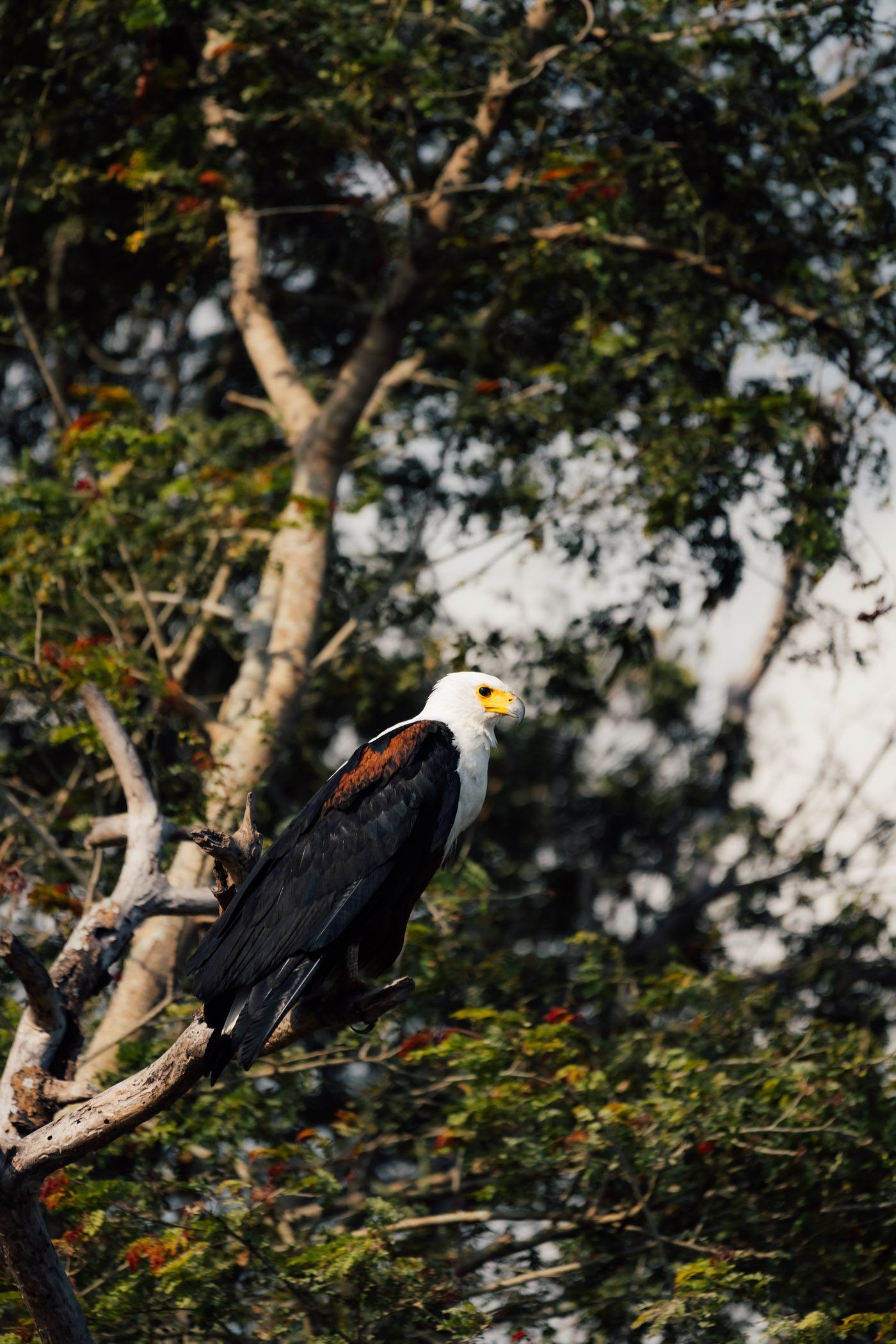
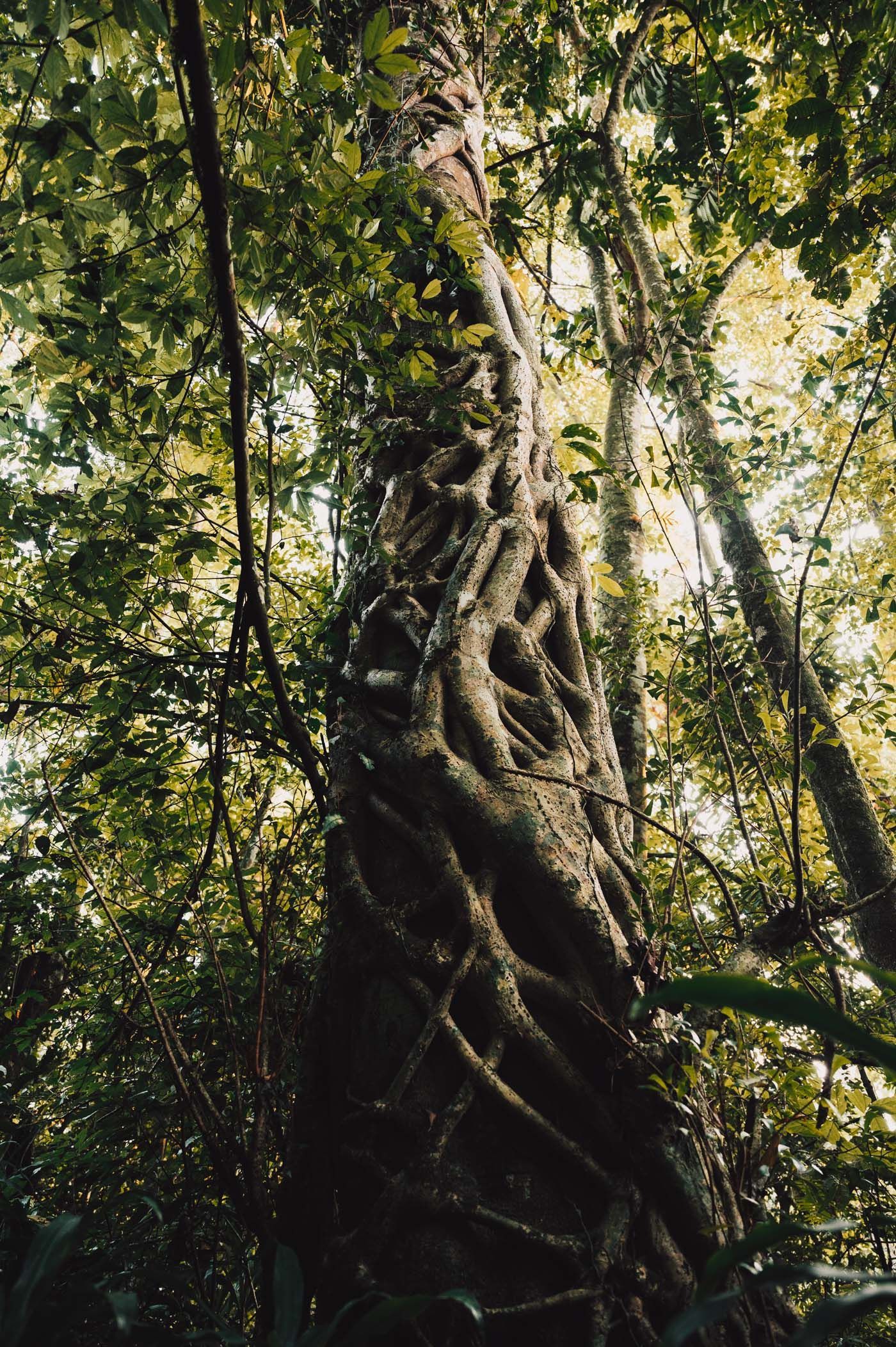
This Is What Wildlife Encounters Looked Like Before Tourism Tamed Them
At 4:30 AM, you leave warmth behind. The drive to Cyamudongo Forest takes you through the rockiest roads imaginable—roads that aren't really roads at all, just paths carved through impossible terrain. You brave cold that seeps through layers. Mist so thick your headlights barely penetrate.
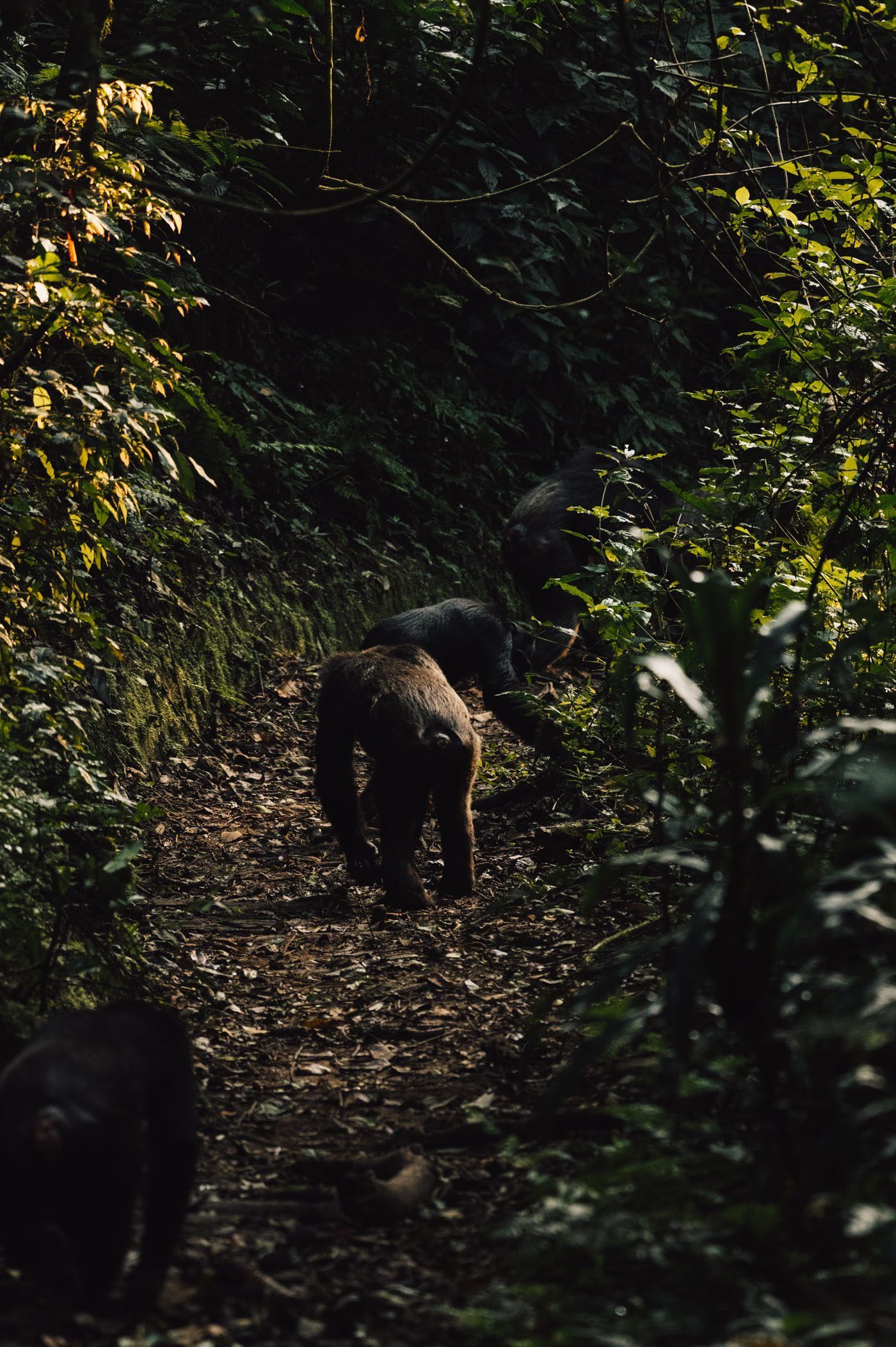
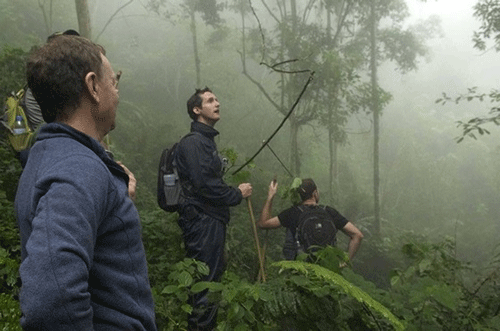
By 5:30 AM, you're entering the forest on foot. Not in a vehicle. Not on established trails. Following trackers who read signs invisible to you—bent branches, knuckle prints in mud, chimp screams echoing from a kilometer away. You're whacking through bush that's never seen human feet. Watching every step because roots want to trip you, slopes want to send you sliding, altitude wants to steal your breath.
The chimpanzees know you're coming. They don't wait like habituated gorillas. They move. Deeper into forest. Higher into canopy. Away from you.
You follow. For three hours. Sometimes six. Your legs burn. Your lungs protest the 2,500-meter altitude. Sweat soaks through despite the cold. Doubt creeps in: Will we even see them?
Then—screaming. Close. The trackers freeze, signal silence. Through dense vegetation, movement. A flash of dark fur. Hands gripping branches. Eyes watching you with wariness, not tolerance. The chimpanzees haven't agreed to this encounter. You've earned it by refusing to quit.
No two people see chimpanzees in the same spot. There are no "guaranteed viewing locations" because the chimps don't perform on schedule. Your feet might be the first human feet to touch the exact patch of forest floor where you finally spot them.
You leave dead tired and rewarded. Because you truly worked for it.
This is what wild looked like before tourism tamed it. Before habituation. Before guarantees. Before roads into the forest. When wildlife encounters required legs, lungs, and humility. When seeing chimps meant you'd worked harder than they had to avoid you.
Nyungwe remains untouched.
The Honest Truth About Nyungwe National Park

Here's what we need to tell you upfront: Nyungwe is our least visited park of the three. Most clients choose Volcanoes (for gorillas) and Akagera (for Big Five). Nyungwe gets skipped.
Not because it's worse. Because it's harder.
The chimpanzees are completely unhabituated. Success rates run 80% - 90% versus 99% for habituated gorillas in Volcanoes. Trek duration varies wildly—two hours on lucky days, eight hours when chimps stay mobile. Physical difficulty is unpredictable until you're in the forest following wherever they lead.
African Parks manages Nyungwe with their own expert guides. These aren't our guides—they're park rangers who've walked these forests for years, who know chimp behavior, who understand that some days you won't see chimps and that's exactly what keeps them wild.
The infrastructure is less developed than Volcanoes or Akagera (untouched). Fewer accommodation options. Rocky access roads. Basic facilities. This is still a relatively green park in tourism terms.
Your permit costs $150 (versus $1,500 for gorillas) not because chimps matter less, but because the experience can't be guaranteed. You're paying for access to completely wild chimpanzees, not habituated performances.
So why do we still recommend Nyungwe? Why include it in Rwanda safari itineraries when most clients would be happy with just Volcanoes and Akagera?
Because some people want the real thing.
It makes you understand better and value the role of conservation. Not as abstract concept. As lived proof that nations willing to prioritize what seems impossible can restore what was lost.
Why Rwanda Left Nyungwe Untouched
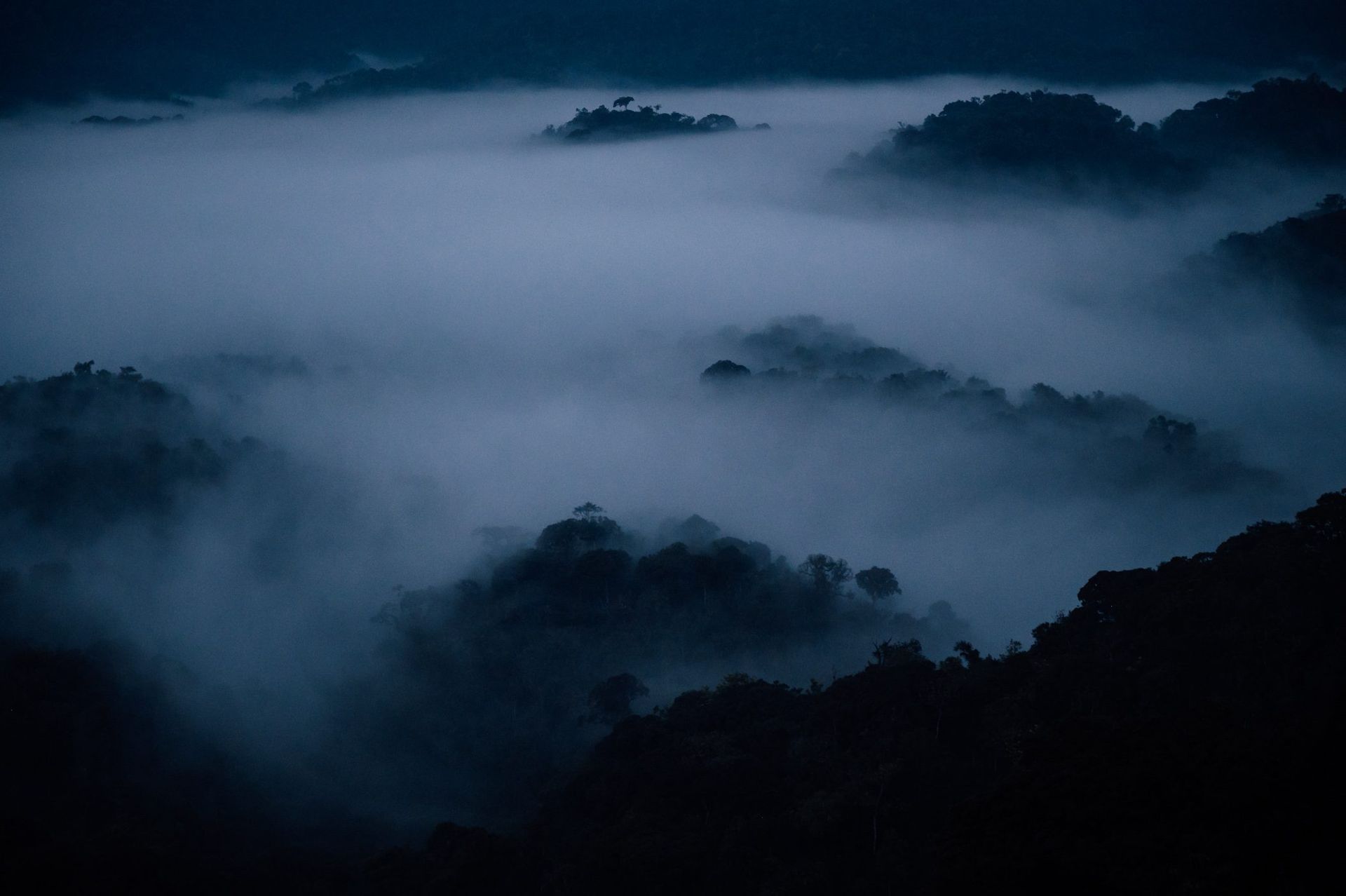
Nyungwe has been protected since 1933 when it was first established as a forest reserve. But protection on paper didn't stop deforestation, poaching, and encroachment. Between 1958 and 1973, the forest lost 150 km² to fires, hunting, and small-scale agriculture. The last buffalo was killed in 1974. The last elephant in 1999.
The 1994 genocide destroyed research facilities at Uwinka. Most staff fled. The park fell into uncertainty.
Restoration began in 1995. In 2005, Rwanda officially declared Nyungwe a National Park—giving it the highest level of protection in the country. In 2020, Rwanda Development Board partnered with African Parks to manage the park for 20 years, strengthening conservation and law enforcement.
Here's what's remarkable: Rwanda could have habituated Nyungwe's chimpanzees like they did with mountain gorillas in Volcanoes. The economic return would be higher—guaranteed sightings command premium prices. Tourists prefer easy.
But habituation changes the animals. Slowly, imperceptibly, they stop being wild.
Rwanda refused that trade.
In a nation rebuilding from genocide with every economic pressure to monetize tourism quickly, they chose to preserve what "wild" actually means. Nyungwe's chimpanzees remain unhabituated not because Rwanda couldn't afford habituation programs, but because they prioritized authenticity over revenue maximization.
This decision has consequences:
- Lower permit prices ($150 vs $1,500)
- Uncertain outcomes (70-80% success vs 99%)
- Harder physical demands (unpredictable terrain, longer duration)
- Fewer visitors (which keeps the forest wild)
Rwanda accepted lower revenue and higher visitor uncertainty to keep Nyungwe authentic. The forest remains untouched. The chimps remain wild.
In 2013, Nyungwe became the first park in Africa to train all guides as Certified Interpretive Guides—a commitment to quality experience over quantity of visitors. African Parks' partnership since 2020 has strengthened this approach: better law enforcement, enhanced conservation, sustainable tourism that protects rather than exploits.
You get something tourism can't buy elsewhere: the real thing.
The Canopy Walk: Seeing Forest Like Chimps Do
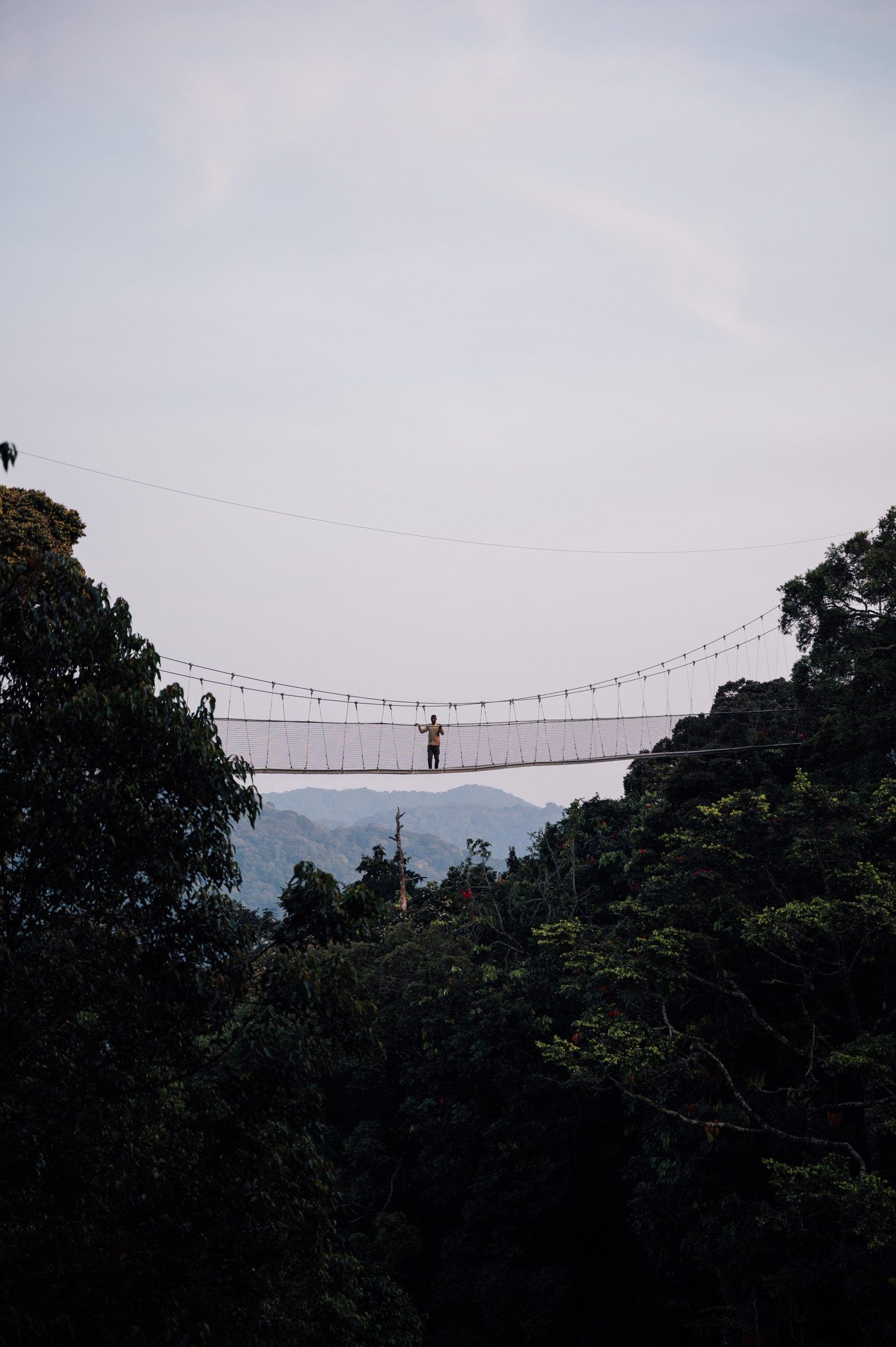
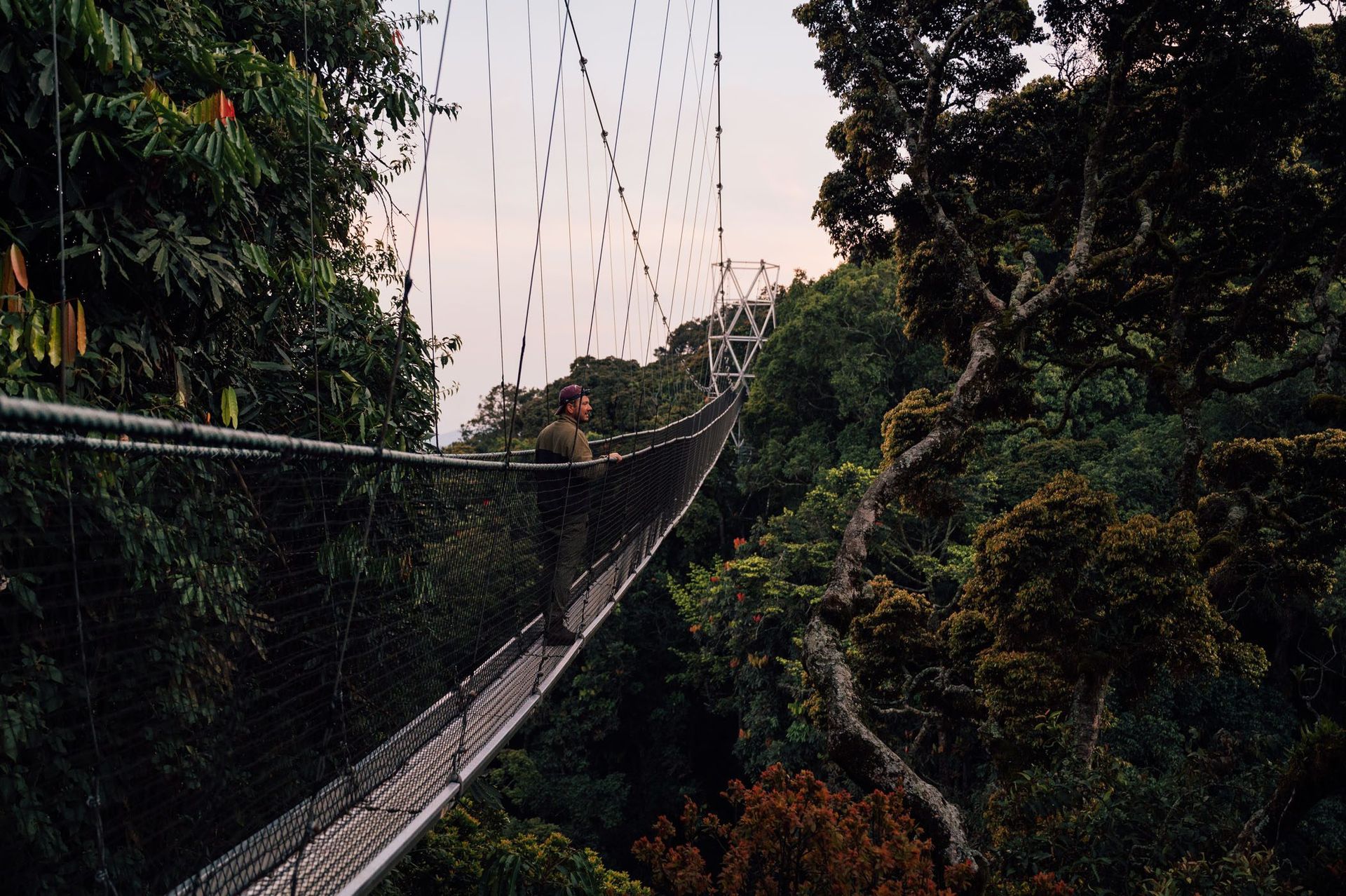
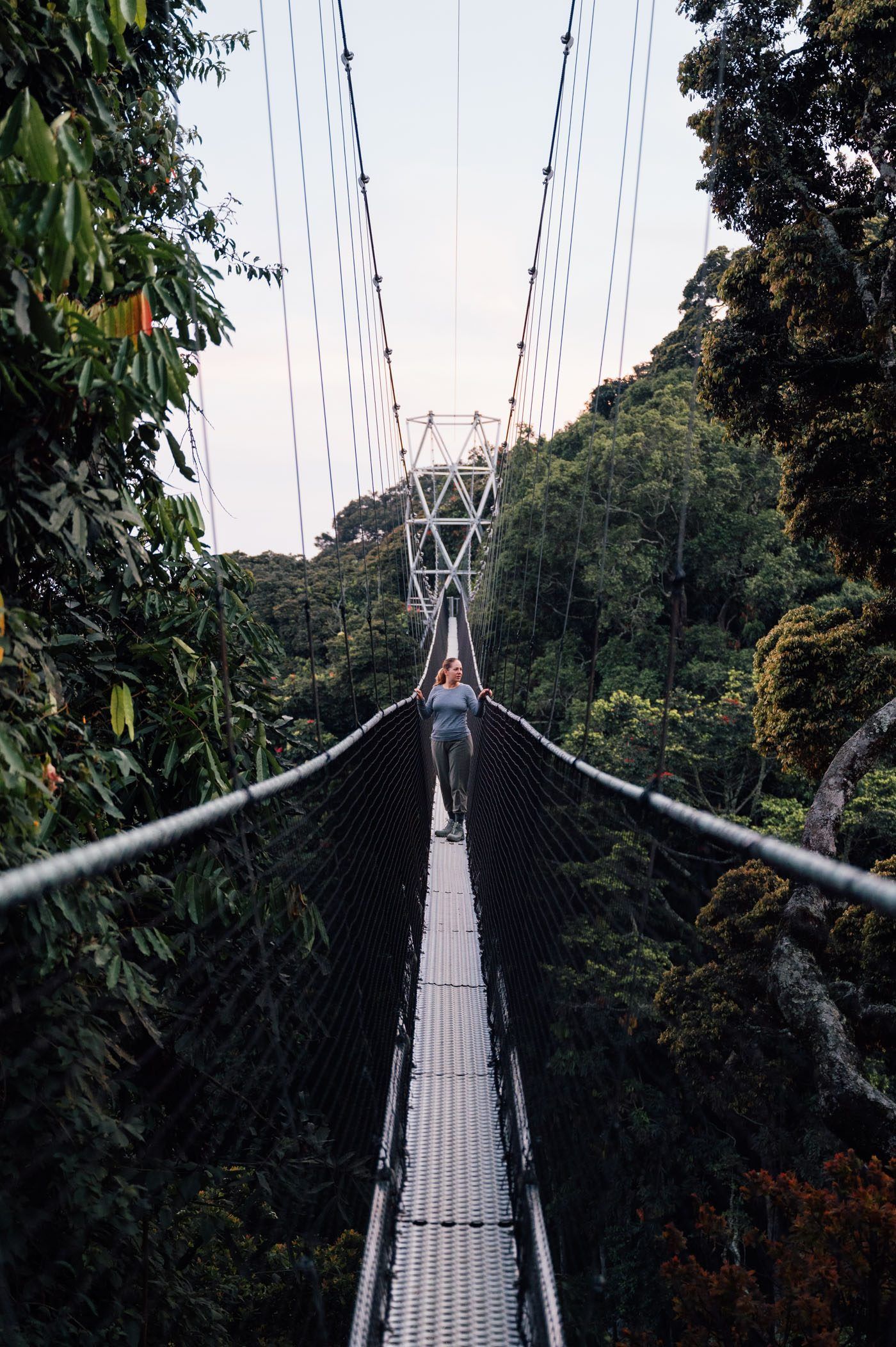
Nyungwe's canopy walk suspends you 70 meters above forest floor for 160 meters. You're walking at the exact height chimpanzees, colobus monkeys, and hornbills live their entire lives.
This isn't about Instagram photos. It's about perspective.
Below you: forest floor shadowed and quiet.
Around you: canopy life—Ruwenzori colobus troops (400+ individuals), birds, endless movement.
Above you: emergent trees reaching another 20 meters higher.
You understand why chimpanzees spend 90% of their time in canopy. Why colobus can travel kilometers without touching ground. Why Nyungwe's biodiversity isn't just about species count but about vertical complexity.
The walk takes 1-2 hours including approach trail. Best timing: early morning (6:30-8:00 AM) when primates are most active, or late afternoon (3:30-5:00 PM) when light makes the canopy glow.
Beyond Chimpanzees: What Else Nyungwe Offers
13 Primate Species
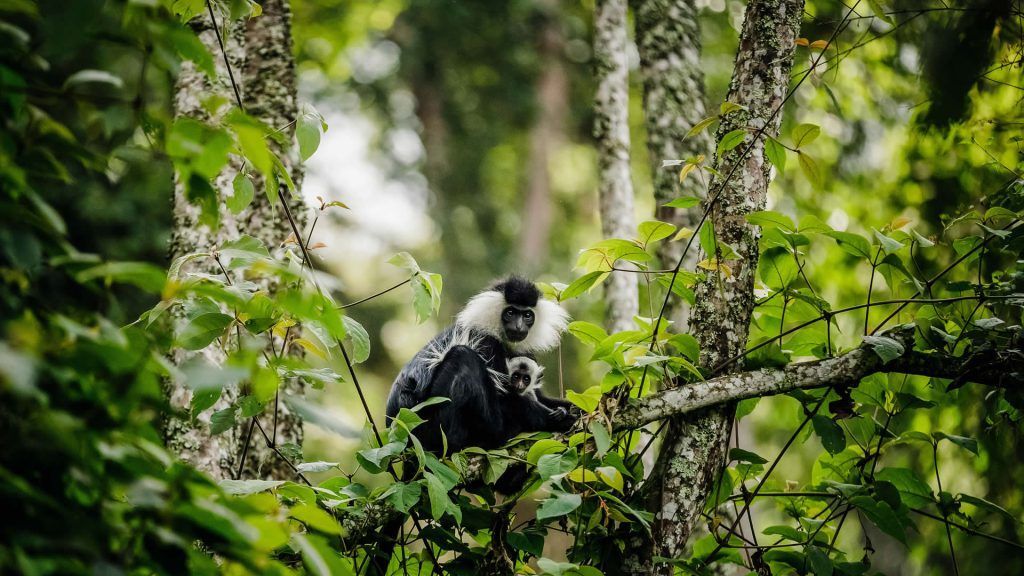
Nyungwe hosts 13 primate species in overlapping territory. Ruwenzori colobus form troops exceeding 400 individuals—the largest arboreal primate troops ever recorded. Watching them travel through canopy, long hair fanning out like parachutes, is spectacular.
L'Hoest's monkeys, red-tailed monkeys, silver monkeys, olive baboons near forest edges. Easy to find near Uwinka headquarters and main trails.
Waterfall Trails & Nature Walks
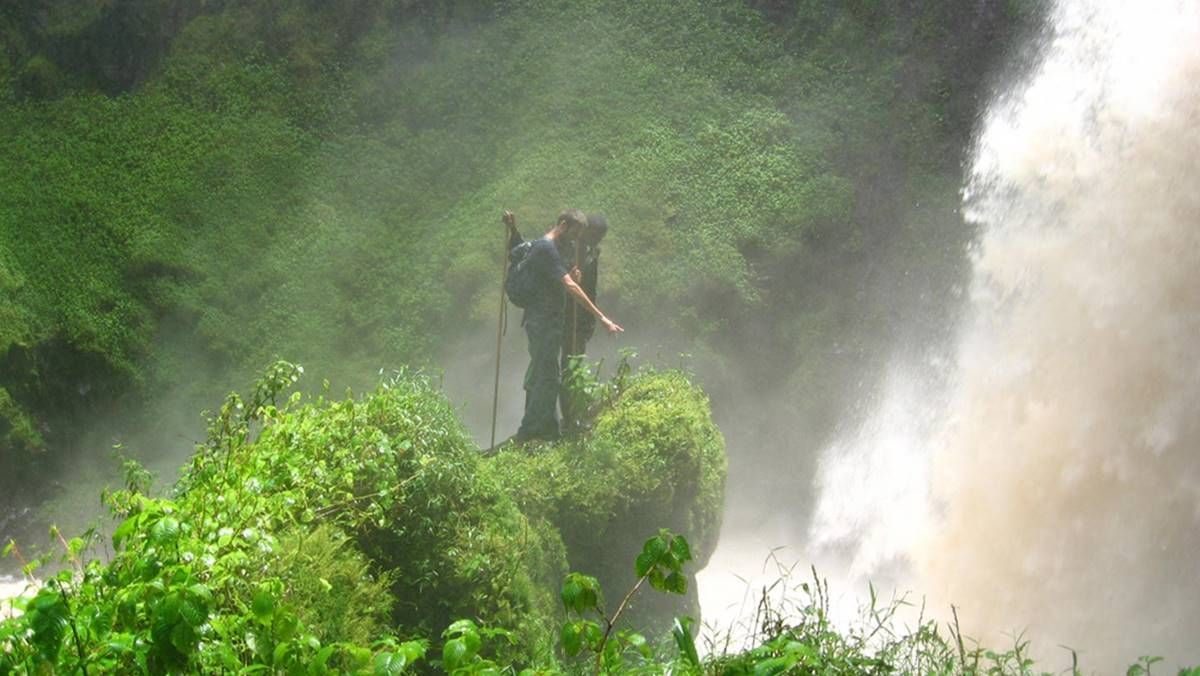
50+ kilometers of trails ranging from 2-hour loops to full-day expeditions. Kamiranzovu Trail leads to waterfall viewpoints. Isumo Waterfall requires full-day commitment but rewards with multiple cascades in pristine valleys.
These aren't manicured tourist trails. Expect mud, stream crossings, steep descents. The effort filters crowds.
[H3] Birding (322 Species, 27 Albertine Endemics)
27 Albertine Rift endemics—species found almost nowhere else on Earth. Ruwenzori turaco, handsome francolin, Grauer's rush warbler, red-collared babbler. Critical habitat that exists almost entirely within these mountains.
Experienced birders log 40-60 species per day. Montane forest canopy makes sightings challenging—you hear birds constantly but seeing them requires patience.
Who Should Visit Nyungwe—And Who Should Skip Chimpanzee Tracking
Visit Nyungwe if you love being in nature. This should be your mecca.
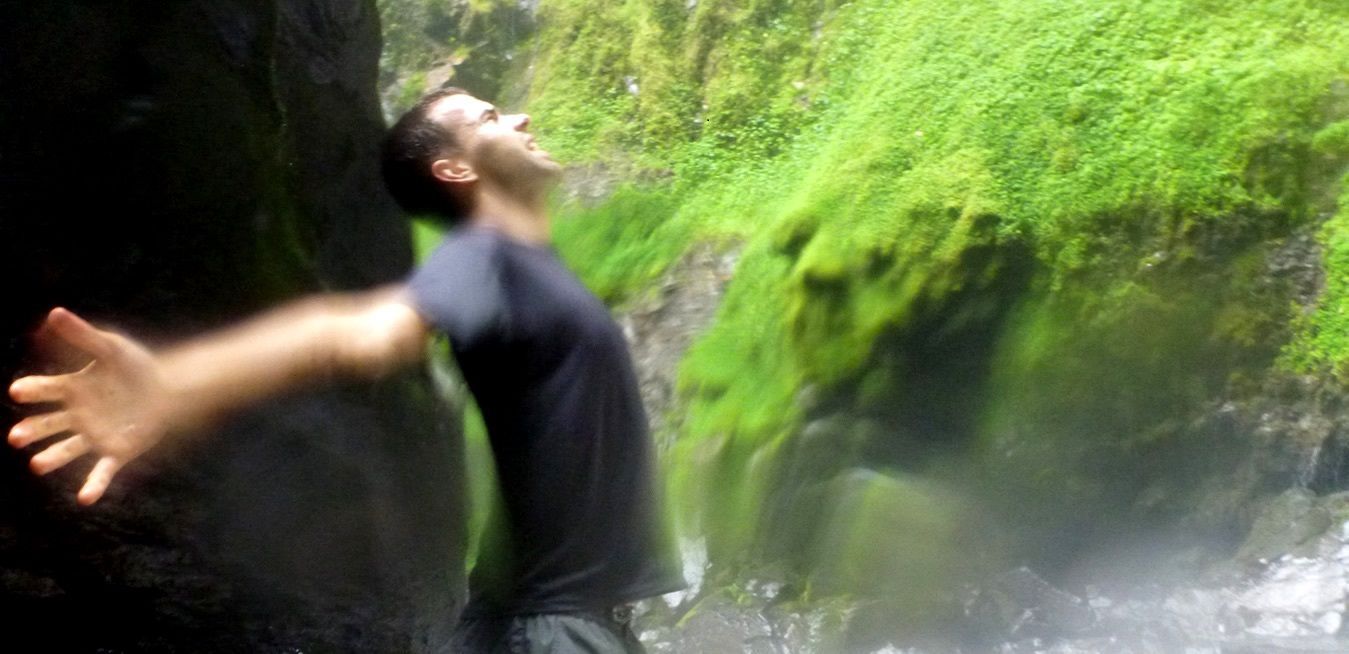
If you've never experienced a pristine rainforest—the smell of wet earth, the sound of water everywhere, the feeling of being inside something millions of years old—Nyungwe delivers that. Most activities here don't require much physically. The waterfall trails, nature walks, canopy walk—almost anyone can do these. They're accessible, rewarding, and put you inside one of Africa's oldest forests.
The chimpanzee tracking is different.
You need to be fit. Not Olympic-level or athlete fit, but fit enough for 3-8 hours of steep, muddy hiking at altitude. No recent injuries. Energy reserves that last. Some endurance. If you've been injured, or your energy levels aren't up, or you're recovering from anything—skip the chimps. It's a strenuous activity that will expose weakness.
But here's what's important: skipping chimps doesn't mean skipping Nyungwe.
The canopy walk alone justifies the visit. Walking suspended 70 meters above forest floor, watching colobus troops (400+ individuals) move through branches, understanding the forest from primate perspective—that's accessible to almost everyone and transforms how you see rainforest ecosystems.
The waterfall trails take you deep into valleys where streams have carved paths for millennia. The nature walks connect you to biodiversity most people never witness—13 primate species, 322 bird species including 27 found almost nowhere else on Earth, plant species science is still discovering.
Visit Nyungwe if:
You want the complete Rwanda safari story: Akagera shows you resurrection (ecosystem restored from devastation). Volcanoes delivers transformation (ego dissolution through gorilla encounter). Nyungwe offers preservation (wild remains untouched) plus the rainforest experience you won't get in the other parks.
You want to leverage the 30% gorilla permit discount: Spending 2+ nights in Nyungwe (or Akagera) reduces Volcanoes gorilla permits from $1,500 to $1,050. That's $450 saved per person. For couples, that's $900—enough to cover your entire Nyungwe experience including activities, accommodation, and transport.
You appreciate authentic over easy: The unhabituated chimps, the untouched forest, the effort required—you understand these aren't weaknesses but exactly what makes Nyungwe valuable.
You love nature: If pristine rainforest calls to you, if you want to walk inside ecosystems unchanged for millions of years, if the idea of being completely immersed in ancient forest excites you—Nyungwe is your mecca.
Skip Chimpanzee Tracking (But Not Nyungwe) If:
You have recent injuries or low energy: The chimp trek is strenuous—3-8 hours on steep, muddy terrain at 2,000-2,500m altitude. If you're recovering from anything, if energy levels are low, if you have any physical limitations—skip the chimps but do the other activities.
You need guaranteed sightings: 70-80% success rate means 1 in 5 treks don't see chimps. If you need certainty, stick with Volcanoes gorillas (99% success). But Nyungwe's other activities are all guaranteed experiences.
You're short on time: If you only have 5-7 days in Rwanda total, prioritize Volcanoes (gorillas) and Akagera (Big Five). Nyungwe requires minimum 2 days and adds 9-10 hours of driving from Kigali roundtrip. But if you have 8+ days, Nyungwe adds the rainforest dimension the other parks don't offer.
Bottom line:
Nyungwe the park is for nature lovers of almost any fitness level. Chimpanzee tracking specifically requires fitness and energy. Choose your activities based on your physical condition, but don't skip the park entirely unless time is the limiting factor.
Need Help?
Frequently Asked Questions